Sunday, October 17, 2010


The Practice of Compassion in Taiwan

So many foreign visitors in Taiwan are in awe of their experience of kindness and hospitality of the people. As a missioner living in Taiwan for 12 years now, here are some examples of this compassion…

A client’s story: She was sleeping for three days in the park. It was pouring rain, suddenly a young woman came to give her a new umbrella and some bread. Another woman helped her make some money for food, by letting her help distribute ad materials from the woman’s work. That was how she endured living for two months in the park.

I remembered when my friends and I were starting to help homeless men and women, we distribute box lunches openly in one of the parks. Several times, after we finished distributing food, there were individuals who would come up to us and donate money for the next food distribution. Some fruit vendors also began to bring their fruits for us to distribute to the homeless people for free.

One day, a woman came did not even want us to let us know her name dropped off a huge bag of vegetable in front of the center. She still comes occasionally.

A Buddhist friend helped the women center find a sponsor from the market. This family sells fresh vegetables and fruits. They give us all kinds of fresh vegetables every week, enough for our weekly consumption at the women center. They do not give us old vegetables.

When Good Samaritan Center started in 2003, we could not afford to buy new furniture and fixtures. Words spread and so many people cleaned up their homes and brought all kinds of stuff that we can use at the center. These goods such as water heaters, blankets, tables, chairs, among many things, were still good and usable.

A woman neighbor who lives next door to the women center, one day came to me while I was watering the plants in front of the center. She said, “Sister, I will give you two baby plants I planted for you. One day you told me you liked this flower very much.” It was a red hibiscus plants. I almost cried when I looked at her, she is not even a Christian, she barely knew me and yet she took so much effort to give me this gift. Now, I have the plants in my apartment’s little garden --- blooming!

Tuesday, August 3, 2010

Learning the Arts of Communication


Many of the clients who came to the center these past two years are homeless women who left their families because of difficult family relationships, many have experienced domestic violence. Last year alone, 91% of the cause of homelessness is due to family problems. To address this situation we planned to hold series of seminars that will address this issue. On July 24th, we invited a professional family counselor from Taichung County Center for Family Education, Prof. Yao Xiu Ching (姚秀情) to give us a workshop on Effective Human Communications. Seventy participants from different organizations signed up to attend the workshop. They told us that this theme is vital to their work and ministry. Prof. Yao gave an excellent presentation on the arts of communications. The atmosphere of the day was very animated and participative. She gave us basic exercises to illustrate different ways of communicating and offered techniques on how to develop good bargaining skills. She used different cartoons and life examples to illustrate how human beings communicate. She had every one of us try is to talk with a partner in three different positions: one standing, other sitting; talking back to back and talking facing each other. Professor Yao also helped us practiced talking and listening to each other, alternately. We were able to observe ways and become aware how the other person reacts to our own voice, tone and expressions. The key point in her talk is about self-preservation. In communicating, all human beings desire three things: to love and be loved, to be affirmed and to be listened. Our level of communicating depends on how much we protect these three and how safe we feel to go deep.

Monday, May 10, 2010

Calling Our Mothers' Presence


Calling Our Mothers’ Presence

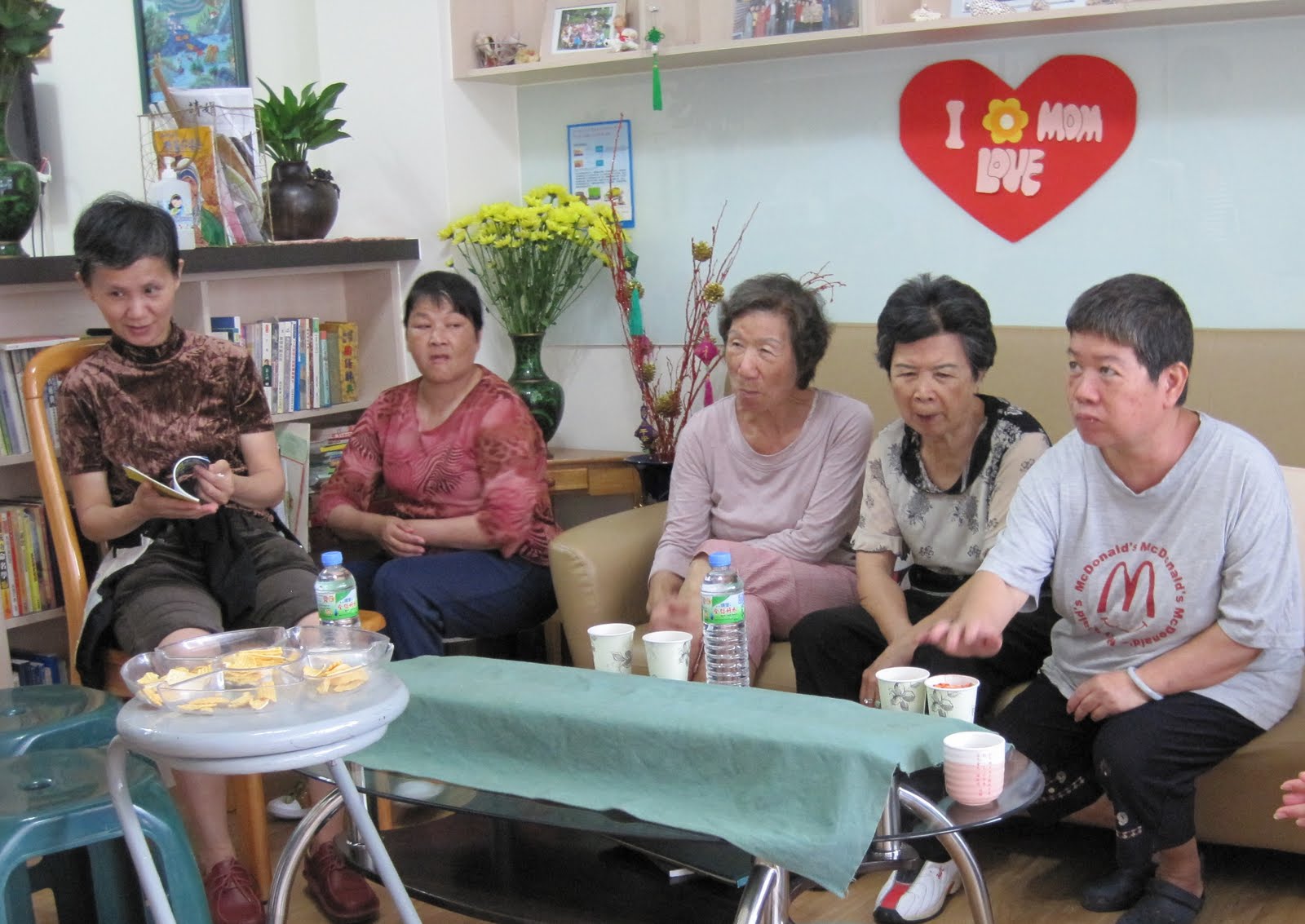
We gathered in circle to say a short prayer to begin our celebration for mothers’ day. I asked everyone to mention each mother’s name loudly, summoning their presence with us at the gathering. I was struck how many of the women were surprised, could not say right away their mothers’ name. Some choked to tears and for some it brought beautiful smiles. We sang together a mother’s day song and prayed for all our mothers. I asked everyone in the room to give a hug to those present who are mothers themselves. The room was filled with laughter and emotions as we greeted each other a happy mothers’ day.

The sumptuous aroma of freshly prepared food from the kitchen brought memories of home and our mothers’ cooking. We all enjoyed and thanked those who prepared it. Suddenly, one of the women left without notice which made us staff worried because of our responsibility to the rehabilitation center where she came from. The happy mood was changed to worry and panic as the Good Samaritan staff tried to find her around the area. One of us spotted her taking a taxi. We went back to the party, feeling disappointed and worried, but we could not do anything but wait for news, until it is time to report her disappearance to the police after 24 hours. About an hour later, the rehabilitation center’s social worker called to tell us she arrived in a taxi. We were all relieved!

The Wellness activity in the afternoon continued. While waiting for the teacher, we painted each others nails. The facial spa teacher came and chose me to be the model, asking everyone to touch my spa pampered face! Then everyone tried to do facial spa on their own! It was truly a women’s day!

Of course, before we said goodbye, we were served “Tiramisu” for Mothers’ Day cake and gave away “red and pink carnations” to the real mothers, and red roses to the misses! We had a father and son guest, so they were also given three red roses for the family’s mom!

Friday, March 19, 2010

Greetings from Norway


Greetings from Norway

We are six Norwegian girls who are very devoted to the thought of helping others overcoming their problems and personal struggles. As part of our Bachelor Program in Social Work, we went to visit Taiwan to learn about social work and how it can be performed in another culture.

We chose to visit Taiwan because we found the thought of this highly developed country with a rising welfare state intriguing, which none of us really knew much about beforehand. After many hours of online research, we were delighted to find an organisation called Good Samaritan. For us, the name of the organisation symbolizes the positive values optimism and friendliness. We sent an email to Sister Marvie where we explained our mission, and that we would appreciate if we somehow would be able to visit this organisation to learn about their work. We arrived in mid-January and stayed in Taiwan for five weeks.

Being in Taiwan, we realised how similar the social problems here are to those we see in Norway. The most striking similarity is the focus on unemployment, the need of having a steady job to go to each day. The Norwegian state has many programs meant for people who are unemployed, and we see that this is also something the Taiwanese government work to implement. Homelessness is common in Norway too. Even though the similarities are there, we realise the causes for the problems may not be the same. And different causes demands different solutions. In Norway the government have the primary responsibility to make sure that people maintain an acceptable livelihood, as in Taiwan they have a different approach. We applaud the voluntary work in Taiwan. It touches our hearts to see how the Taiwanese people are willing to donate both their time and money to help those in need.

One thing that really struck us about Taiwanese culture is the friendliness and openness that met us wherever we went. This is perhaps the most striking difference if we are to compare Taiwanese and Norwegian culture. We met people who were willing to help us with everything we needed, and we always felt welcome. This of course also includes Sister Marvie and everyone at Good Samaritan. Without them, we suspect that we would not have learned anywhere near as much as we did. Always willing to help us, whether it was guiding us around Taichung city, or helping us get in contact with other resourceful people.

During our stay, we were able to observe how Good Samaritan work to help homeless women. We joined them on their tours around town to hand out food, water and blankets, and saw the joy this brings. Also for the women who use the center, we saw that the Good Samaritan is a place of warmth and respect where people always work hard to make everyone feel like part of the community. They share stories, some of them similar to each other, and find strength in the bonds they have with each other. Everyone is treated equally, yet everyone is always free to be themselves and grow in their own pace.

We find the work Good Samaritan important. Being able to observe how much of an impact the center has on the lives of the people in the community is impressive.

One important thing we learned is this: one does not need to speak the same language to communicate. We will always remember the nights where we sat with the women at the center, watching films, sharing meals, and playing cards. Even though we did not understand much of the words, we still felt like we were able to communicate well. One does not need a common language to understand the meaning of a smile.

We would like to thank everyone at Good Samaritan Center for their time, and for making our stay in Taiwan an unforgettable experience.

Best wishes,

Aase, Ailin, Grete, Maren, Odrun and Rebeca

Saturday, February 13, 2010

A New Year Homecoming


A New Year Homecoming
February 12, 2010

The annual tradition of Lunar New Year homecoming for all the women here at the Good Samaritan Center gives a glimpse of a what could be what Jesus envisioned about a party. I was reminded of what He said, “when you give a feast invite those who are found in the streets ---the lame, the blind, the handicapped, the lepers …and so forth.”

In front of the center is a little garden, greeting everyone is a profusion of colors from the blooming flowers as if alerting us of the new spring, and of the hope that lies in the new year of the Tiger! As soon as we opened the doors, some of the women came in early, bright and chirpy like our pet birds! We quickly set up the tables outside, arranged the chairs, put the ‘hor d’oeurves’ (consist of pumpkin and sunflower seeds, mix nuts and rice cookies) and hot tea and juice drinks on the tables. The women came in their best, even if their best is a dirty looking sweater. As soon as they found their spot in one of the chairs, the party began for each of them. Chatting and eating away. Towards half of the morning, we could not hear each other because of the loud voice that is trying to outdo each other telling their adventures and plans for the holidays. Yet, some, seemed comfy in their little corner avoid conversations. Still, everybody is polite and happy to greet each other a greeting for the new year.

Some of our residents were busy helping prepare the food upstairs. One by one, the trays of vegetables and other ingredients for the ‘huo-guo’(hotpot – a mixture of everything in a boiling soup) are being brought down to the buffet table. Then more women came, including two former residents now living in a rehab center picked up by our social workers. A huge van parked in front of the center bringing three more former clients who now live in a supervised living facilities came. One came being pushed in a wheelchair by one of our volunteers. One woman came in drunk and looking pretty dirty, so we asked her to clean up and shower to feel better.
We started with the activities, beginning with Chinese calligraphy contest. All the women were asked to write ‘New Year blessings’ on red rolls of paper to make ‘chun lien’, or spring door greetings. One of the women amazed us as she sat down, poised like a skilled calligrapher and started to write a classical greeting. She was so focused writing as if she were another person. We all remarked how good she was. After she finished, she told me with pride in her eyes, “Sister, people took me as stupid (but I am not)!” She won the contest. Then, our Korean volunteer brought two Korean dresses for the women to try on. This was a hit! Everyone wanted to try it and take a picture. It was a lot of fun and gave the women a sense of beauty. Just before we finished setting the long table, we invited everyone to a prayer honoring the ancestors. It is a Chinese New Year tradition that is delegated to only the oldest males in the family. We changed it a little bit, so that all the women will have chance to bow in reverence and thanksgiving to God and their ancestors. Each woman offered incense and we all bowed down in front of the Cross and the altar with our surnames written on it and we finished off with a prayer holding our hands in a circle.
And so the table feast begins! Everyone enjoyed the tastes and smell of the parade of food freshly prepared and cooked upstairs in our kitchen.
After everyone quieted down with bellies full, we asked everyone to sing a lively traditional New Year song to greet each other. We could feel the excitement in the air, as we asked everyone to sit down and we will give the red envelopes. They all shouted happy New Year and clapped. Then we sang again and again. Everyone helped cleaned up. We said goodbye as we greeted each other once again.

Wednesday, December 9, 2009

New Challenges for Homeless People: Election Induced Enforcement


New Challenges for Homeless People: Election Induced Enforcement


It was almost 9:30 p.m. yet we were still preparing the boxed noodles, soup and oranges. We are going to distribute them during our outreach that night. The temperature had drastically dropped and the wind added to the bitter cold.

When we finally took to the streets, it was past 10 p.m., we were a bit late than usual. We decided to go Tungkuang Road Park on the east, however, there was not a single homeless person. Next destination was the Tzu-you park, amazingly, it was clear of the usual people we serve at night. We went to the Taichung Park, we saw a group of men and a woman, when we approached them, the group was not very friendly. I have seen the women hanging around the park few days ago. We walked inside the Taichung Park and its vicinity, again, there was no one around, by this time we begin to wonder where were the homeless folks who used to rest in those areas gone. We went to the Taichung Station, walked around checking, again, there was not a single soul. Instead, a policeman approached us, asking who we were looking for. We told him that we are visiting some clients who sleep inside the station. He said, “There is no more homeless people here”. We asked, “Why not? Where are they?” He said, “They are not allowed around the Station and main thoroughfare, Mayor Hu, have given us orders to clean up the Station of the homeless people, they look dirty and pedestrians/passersby are afraid of them.” So, that explained the absence of all the homeless people in the vicinity. After realizing this situation, we started to think where they might be. Thus, we went out of the central area, and there we found most of the folks, sleeping out in the cold. We found most of them towards the northern section near the railroad tracks. We spotted a middle-aged man sleeping in one of the bench at Tungkuang Park, we gave him some food and sleeping bag. He was drunk, he barely responded to us. While we were talking to him, a group of policemen stopped by and came to check on us. They immediately asked the man to get out of the park, even he could not stand. One of the police officer told him to go to the Men’s temporary shelter in Da-kong Street. I asked the police officer if he knows whether the shelter is open at that hour and will accept the man. He said he does not know for sure. The police said they want the street sleepers to go to the shelter because they could die of cold.

It was already past midnight, so we decided to end our night outreach. I wondered where that man went to sleep, after the police asked him to leave the park.

Although, it is true that some homeless men are drinking around the area of train and bus stations, it is not true of all the homeless population. The well-lighted train and bus stations are places of safety for them, from cold and other hate crimes against homeless. Homelessness is a delicate public issue. Election is coming and politicians will use them to measure how the incumbent government served its population. Mayor Hu of Taichung City has done so much to ease the suffering of homeless people in Taichung by encouraging homeless service providers to exchange views and experience through Social Welfare Department meetings. We hope that he will continue to support them and their service providers and not crackdown on homeless.

December 3, 2009


Thursday, November 5, 2009

Outing in Tao-Mi and Nantou Mountains


Outing in Tao-Mi Village and Nan-Tou Mountains

The staff and Board members of Good Samaritan Women Concerns Association had a weekend outing in Nan-Tou county. We arrived at Sun Moon Lake just before 3 p.m. and decided to take a boat ride around the lake. Our boat docked at various tourist spots inside and around the lake. Our first stop was a floating garden, of what used to be a small island in the middle of Sun Moon Lake but submerged during the 921 earthquake 10 years ago. The floating boardwalk and planters provided a 360 degree angle to see the surrounding hill around the lake. The next stop was the Suen Kuang Temple, from the dock we climb uphill for about 15-20 minutes to reach the temple. There were so many tourists from China, eager to take pictures and pay respect to the statues at the temple. From the temple, we went to the aborigines’ village. There was a group of aborigines, belonging to Taya tribe singing. One of them invited me to dance and some in our group also joined in. It was so much fun to dance with aborigine dancers and their music. We walked around and bought some food like grilled sausage, a beverage with rice wine, sliced guava and fried little fishes from the lake. We came back to the port just in time to go to our destination for the night. We rented a private bed and breakfast place in Tao-Mi, Puli district. We got there just before dark. The owner Mr. Liu, welcomed and showed us our rooms. The rooms are built next to the owner’s house, has a rustic flavor to it. The rooms resembled a Japanese style accommodations with wooden floors, the beds are thin foam sprawled on the wooden floor. At the back of the main house, is a huge refectory where they serve the meals for their guests. That night, we enjoyed a sumptuous meal prepared by Mrs. Liu. After dinner, Mr. Liu invited us to go frog watching at around 7 pm. Before going to the river he took us to the famous “Paper Church” or “Paper Dome”. A beautifully engineered open building made of paper columns. It was impressive. The design and paper columns were a donation from Japan, to commemorate the 921 earthquake. After the 921 earthquake, the residents of this little village Tao-Mi did not have much left and rehabilitation was needed. The New Homeland Foundation in cooperation with the government trained the residence of this village into eco-tourism. Tao-Mi is home to Taiwan swamplands. The village changed their mindset into environmentally concerned citizens. Each year, the residents have two training on how to be eco-tour guides. We went down to the river wearing our rubber booths and flashlights looking for different kinds of frogs. Later that night, after we came back, Mr. Liu prepared tea for our group. The theme of the whole village is frog. Even the restrooms are designed like sitting frogs!

The next day, we were served a hearty breakfast after everyone came back from morning walk in the surrounding villages. We had a short morning prayer together. Just before 9 am, we all left the Tao-mi and went into the walking trail in the swampland area. All 7 of us tried the pulling trolley that takes us to the other side of the swamp filled with lilies…it was a great idea! Afterwards, we drove around the valley and mountain roads until we reached the top of the Second Mountain of 9 Mountains. On top of this mountain is a one-story house tipped into a sliding position by the 921 earthquake. Apparently, the mountain which was 2 km away from the house became their backyard after it moved forward to where the house is. This
place was the memorial site of the 921 earthquake. Further up, we went to the place where they called “mountain explosion”.
The entire side of the mountain rolled down to the valleys. It was quite, very few onlookers were there. Truly, it was a powerful reminder of the continuing movement and change of earth’s surface which is catastrophic to those who inhabit the mountainside. The residents had a change of heart, they know they have to live harmoniously with their environment.
We went home and enjoyed “huo-guo” for lunch at Kao A-yi’s restaurant. Nowadays, the little bamboo plant from Tao-mi is beginning to adopt in our little garden in front of the center.